|
Born in New Orleans, O’Neil De Noux is
a prolific American writer of novels
and short stories with 33 books in
print and over 350 short story sales.
Much of De Noux’s writing is
character-driven crime fiction,
although he has written in many
disciplines including historical
fiction, children’s fiction,
mainstream fiction, science-fiction,
suspense, fantasy, horror, western,
literary, religious, romance, humor
and erotica.
Mr. De Noux was educated at Archbishop
Rummel High School before moving on to
Loyola University and securing a
Bachelor of Science degree in European
History at Troy University in Alabama.
He is a US Army veteran and worked as
an FBI Clerk and with the Jefferson
Parish Sheriff’s Office, where he
served in the Intelligence Division,
the Regional Organized Crime Center
and as a road deputy. Promoted to
homicide detective, Mr. De Noux earned
seven commendations before being named
Homicide Detective of the Year. He is
a graduate of the Southern Police
Institute of the University of
Louisville. A lucrative position as
chief investigator with a New Orleans
private investigative firm drew Mr. De
Noux into private practice for eight
years. He returned to law enforcement
with the St. Bernard Parish Sheriff’s
Office as a detective before moving on
to work as a magazine editor and
graphics designer. When his house was
severely damaged by Hurricane Katrina,
Mr. De Noux relocated to the
northshore of Lake Pontchartrain for
his final stint in law enforcement as
a police investigator at Southeastern
Louisiana University, Hammond, LA. He
retired in 2017.
O’Neil De Noux’s writing has garnered
a number of awards including the
UNITED KINGDOM SHORT STORY PRIZE, the
SHAMUS AWARD (given annually by the
Private Eye Writers of America to
recognize outstanding achievement in
private eye fiction), the DERRINGER
AWARD (given annually by the Short
Mystery Fiction Society to recognize
excellence in short mystery fiction)
and POLICE BOOK of the YEAR (awarded
by PoliceWriters.com). Two of his
stories have been featured in the
prestigious BEST AMERICAN MYSTERY
STORIES annual anthology (2003 and
2013).
In 2012, O’Neil De Noux received an
Artist Services Career Advancement
Award from the Louisiana Division of
the Arts for BATTLE KISS, a 320,000
word epic of love and war set against
the panorama of the Battle of New
Orleans. In 2013, USS RELENTLESS was
published, a saga of the US Navy in
the Age of Sail chronicling the
exploits of a young American naval
officer from the Barbary War in 1803
through the War of 1812. In 2016, De
Noux’s World War II novel DEATH ANGELS
was published.
He is a past Vice-President of the
Private Eye Writers of America and was
named 2015 Literary Artist of the Year
2015 receiving the President’s Award,
St. Tammany Parish Art’s Council, St.
Tammany Parish, LA
.
O’Neil De Noux is the author
of Blue Orleans, Grim Reaper, Specific Intent, Crescent City Kills, Lastanza: New Orleans Police Stories, The
Big Show, and New Orleans Confidential.
According to the book description of
Crescent City Kills, “When the bodies of two junkie prostitutes wash up on the shore of the
river in Algiers, La Stanza defies orders and hits the streets to investigate, using his sexy new partner as bait.”
One reader of Crescent
City Kills said, “This is the fourth book in a series about a New Orleans homicide detective named Dino
LaStanza, who is loosely based on the author, an ex-homicide cop himself. It's also my favorite of the series, although
I've bought and read them all. The books are definitely hardboiled, filled with all the warts and scabs of serious police
work. I've heard some people criticize the character of LaStanza's girlfriend, Lizette, as being unbelievable. Let
me tell you, she's a real person, though not so rich as in the books. There's a rumor that it's her legs that
grace the cover.”
Publisher’s Weekly said of Lastanza:
New Orleans Police Stories, “DeNoux's series character, New Orleans homicide detective Dino LaStanza,
is featured in a collection of gritty noir short stories. (The last novel in which LaStanza appeared was 1988's The Big
Show.) Like his protagonist, DeNoux has been a New Orleans police detective, and his years of grim experience in a city with
a soaring murder rate are reflected in these dark tales of life on the very mean streets. These stories are not only hardboiled:
they are raunchy, violent and filled with obscenities. Each short narrative follows one of LaStanza's cases. The tales
are unremittingly bleak: a beautiful young woman commits suicide; a jogger is attacked by a gang; an elderly woman is killed
by random gunfire. Unfortunately, DeNoux's prose is labored and stiff, his characters are cardboard and his plots are
thin and predictable. The best hard-boiled writing compresses powerful emotion into tight, minimalist prose. While these stories
display plenty of tough attitude, there's not a lot of feeling in De Noux's choppy sentences.”
One reader of Lastanza:
New Orleans Police Stories said, “I've been in love with O'Neil De Noux's books since I first
laid eyes on them many years ago. "Lastanza: New Orleans Police Stories" fills in some gaps in NOPD Homicide Detective
Dino Lastanza's career for those of us already familiar with him and gives readers who are new to him a wonderful insight
to his character. I've read all of De Noux's books many times over and I never tire of them. This is what homicide
is like in the real New Orleans!”
According to the book description of
New Orleans Confidential, “Come prowl the lonely, sometimes violent streets of America's
most exotic city, the city that care forgot, New Orleans, with a lone-wolf private eye named Lucien Caye. Caye lives and works
in the run-down New Orleans French Quarter of the late 1940s. Women float in and out of Caye's life, like the alluring
brunette who wants him to bodyguard her while she poses for sexy pictures. Murder is often the name of the game and Caye sometimes
leaves town for the gulf coast or the swamps of southern Louisiana in pursuit of the truth, usually aiding a pretty woman
in need of help, in more ways than one. Unfortunately, the truth is often ugly, often dangerous and usually resides on the
loneliest part of town.”
One reader of New
Orleans Confidential said, it “is a mix of noir mysteries and heart-wrenching tales with two common threads:
First, the stories are set in the late 1940s New Orleans (with realistic descriptions of that exotic city long before the
levees broke); Second is the leading character, Private Eye-Lucien Caye, a tough guy with a heart.
Caye, a WWII vet and former NOPD
cop, is now a PI, living and working in the shabby lower French Quarter after the war. He is different from the your typical
PI. He doesn't smoke, drinks only on occasion, rarely wears a hat because it messes up his hair and will bend (and sometimes
break) the law to mete out his own form of justice.
The cases come to him in classic
PI fashion - pretty damsels in distress, jealous spouses, dangerous femme fatales with murder and lust in their hearts, sexy
women with an eye for good looking men (like Caye) and precarious situations. The cases come with heartfelt appeal - a little
girl looking for her lost cat, a boy looking for his runaway father, a letter from a child asking Santa to take him to the
angels because his parents haven't enough food and daddy won't eat, giving his food to the boy and his mommie. Lucien
Caye attacks these cases with determination. There's even a ghostly trek into the swamps and a love sorceress. He won't
give up and you won't put this book down. While some of the stories are G-rated enough to have been
published in airline magazines, some are violent, profane and extremely erotic.
O'Neil De Noux's talent goes
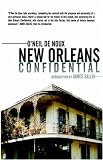
beyond the penning of the stories. This reviewer has learned the photo which adorns the cover of the book was taken by De
Noux. It is the photo of the building on Barracks Street in New Orleans where Lucien Caye's office and apartment are located,
a building thankfully spared by Hurricane Katrina. It's a the corner of Barracks and Dauphine Streets.”
One reader said of Blue
Orleans, “Before Katrina tore up the levees and devastated New Orleans, it could have been called Blue
Orleans, especially in the Calliope Housing Project. Murder and mayhem were noticeably daily happenings. This day, when Dino
is called out to investigate a murder, he walked down Common Street wondering "where is everybody?" When he turned
on Baronne, he ran headlong with panicky people running here and yon in their quest for freedom. The 300 block of Baroone
looked like Mardi Gras. A huge crowd was massed all the way to Union Street on both sides of the street.
He sees an elderly lady about
80 years old dressed in her pink chiffon gown with a short fur coat draped over her feeble shoulders watching as another victim
of this hoodlum is at the door of the NOPSI building and another body hanging beneath the overhang of that same place. Usually,
most of the action takes place late at night or in the early hours while the painted ladies of the night ply their trade.
Dino seeks not to impinge on the territory of the gangs, as he wants to survive this day to find more bodies scattered around
this sinful town. In downtown area, a berserk gum is rampaging throughout shooting at random. Nobody is safe. One bound corpse
is discovered murdered execution-style, bullet to the brain.
He finds a witness who vanishes like
a puff of smoke, like Haslam tends to do when he wants to avoid the public. This writer also penned GRIM REAPER soon after
this one was published, and two short stories "Maria's Hand" and "Guilty of Dust and Sin." New Orleans
is the perfect place to find sin in all the different ganglands and projects. Nowadays, a good many of those are living on
the streets of Knoxville, which will soon become known as Sin City with all those liquor stores and drinkers swaying to and
fro on the main street of town. The place will be overrun with the homeless and this mayhew Dino is familiar in his hometown
will soon be in mine. It's a dirty shame for a rich mayor to allow the poor of New Orleans occupy and tear up the housing
while the poor of this town is denied even to apply for the same. Blue Orleans is not for the blues, which was developed in
Memphis. New Orleans is a jazz town, with some of the notables still hanging in and avoiding the water moccasins which have
taken over the deserted part of town.”
|
|
 |
|
According to the description of Guilty
of Dust and Sin, an Amazon Short, “This is a mystery story featuring New Orleans private–eye Lucien
Caye, who has appeared in previous stories in Hemispheres In–Flight Magazine of United Airlines and anthologies such
as Flesh & Blood: Guilty as Sin and Fedora 2. A Lucien Caye short story is forthcoming in Alfred Hitchcock Mystery Magazine.
A Lucien Caye short story collection, entitled NEW ORLEANS CONFIDENTIAL will be published by Point Blank Press in 2005.”
According to the description of Maria's
Hand, an Amazon Short, “"Maria's Hand" is the seventh short story featuring 1890s Det. Jacques
Dugas, the lone French detective on predominantly Irish New Orleans Police Department. A brainy investigator, Dugas previously
solved 'The Gorilla Murders' as well as the 'Murders Along the Rue Frenchmen' before he is called to investigate
a trunk found with a woman's severed hand inside. Dugas's only lead is a thin, gold wedding band with no inscription.
During the steamy summer of 1891, Dugas must track down the victim before he can track down her killer.”
According to the book description of
The Big Show, “The fifth in the series of DeNoux's acclaimed Dino LaStanza murder mystery
series, "The Big Show" follows LaStanza -- a top New Orleans homicide detective -- in his latest case, involving
a man horribly burned, a white supremacist leader who may have been involved in the crime, and a parallel case of the Pantyhose
Rapist. Fast-paced, realistic, raw and often funny inside look at the day-to-day workings of police in the line of fire.”
According to one reader of The
Big Show, “If you want to know what New Orleans is really like, if you want to see how police officers
deal with the most horrible crimes, if you want to read about real police officers, then READ THIS BOOK. If you're looking
for Hollywood versions of cops, if you're looking for in-depth studies of criminal's minds, if you're looking
for Mardi Gras or Jazz Fest or other New Orleans tourist things, then there is no reason to read THE BIG SHOW.
Veteran Homicide Detective Dino
LaStanza turns the wrong way down a one-way street and almost runs over a burning man stumbling across a quite uptown street.
LaStanza burns his hands putting the fire out. The man dies and for the next 320 pages, LaStanza works relentlessly to solve
this heinous crime. Meanwhile, LaStanza and his partner Jodie Kintyre must catch a serial rapist who murdered his last victim.
This is life in the big pressure cooker, in the overworked New Orleans Police Homicide Division, the big show of police work.
The streets of New Orleans are
never better described than in De Noux's work, a former homicide detective. These books are not for everyone. They are
uncompromising in their portrayal of cops who would never win a popularity contest. Years of witnessing violence has effected
them. They see life differently than we do. De Noux shows this from the inside. What De Noux doesn't do is glorify the
killers. In THE BIG SHOW, we don't get into the killer's heads, we see them only as the police see them. We walk the
streets, talk to real New Orleanians, see how cops use gallows humor (which De Noux does better than anyone) to release the
tremendous tension that comes with the job of hunting killers.
LaStanza is unique. He's
Sicilian-American, born of immigrants into a city whose culture is still dominated by ancient families. Unlike clichéd
cops who drink too much or who are down-and-out bachelors roaming the streets like alley cats, LaStanza is not an alcoholic
and is married (luckily to a rich woman). He gets to drive a Masera! ti (which was stolen in the previous book on this series,
pretty damn funny because LaStanza was cocky enough to drive it around the seedier parts of town). His wife, Lizette, is far
smarter than LaStanza (she's a graduate student) and an extremely sexy woman. This may frighten some readers, because
Lizette knows the power of her sex. Sometimes, she's too much like a Playboy bunny, but this IS fiction. Few writers can
write a sex scene as steamy as De Noux.
What De Noux does here is put
a working class cop in a mansion with a beatutiful wife and servants, providing LaStanza with an automatic inner conflict.
It bothers him to be rich. He leaves this comfortable life every morning for the bloody streets. It's typical New Orleans,
rich vs. poor, uptown vs. inner city, Sicilian-American vs. everyone else.
The other supporting characters
are very interesting. Jodie Kintyre, LaStanza's deadly serious partner, is a methodical, committed detectives with great
inner strength. Paul Snowood, the cowboy wannabe, constantly provides humorous relief (sometimes annoyingly). Stan-The-Man
Smith is even more annoying, a scene-stealer who sometimes lives up to his nickname of Psycho. The killers are chilling because,
as in real police work, we only see them briefly, in violent snapshots. We don't get much about the victim's lives
either, again because cops don't have time for a biography of their victim. Cops are too busy trying to catch the killer.”
About the Jefferson
Parish Sheriff’s Office The first Sheriff of Jefferson Parish was S. Kerner who served from 1866 to early 1867. Today,
the Jefferson Parish Sheriff’s Office is a full-service law enforcement agency with an authorized strength of nearly
1600 sworn and non-sworn personnel. The patrol function of the Sheriff are handled by the operations bureau
who are geographically organized into four districts. Within the Jefferson Parish Sheriff’s
Office’s Special Operations Bureau the function of SWAT, Street Crimes, Arson and Helicopter services can be found.
The Criminal Investigations Bureau handles typical investigative functions such as crimes against persons, burglary, auto
theft, robbery and homicide.
|
|
|
|
|