
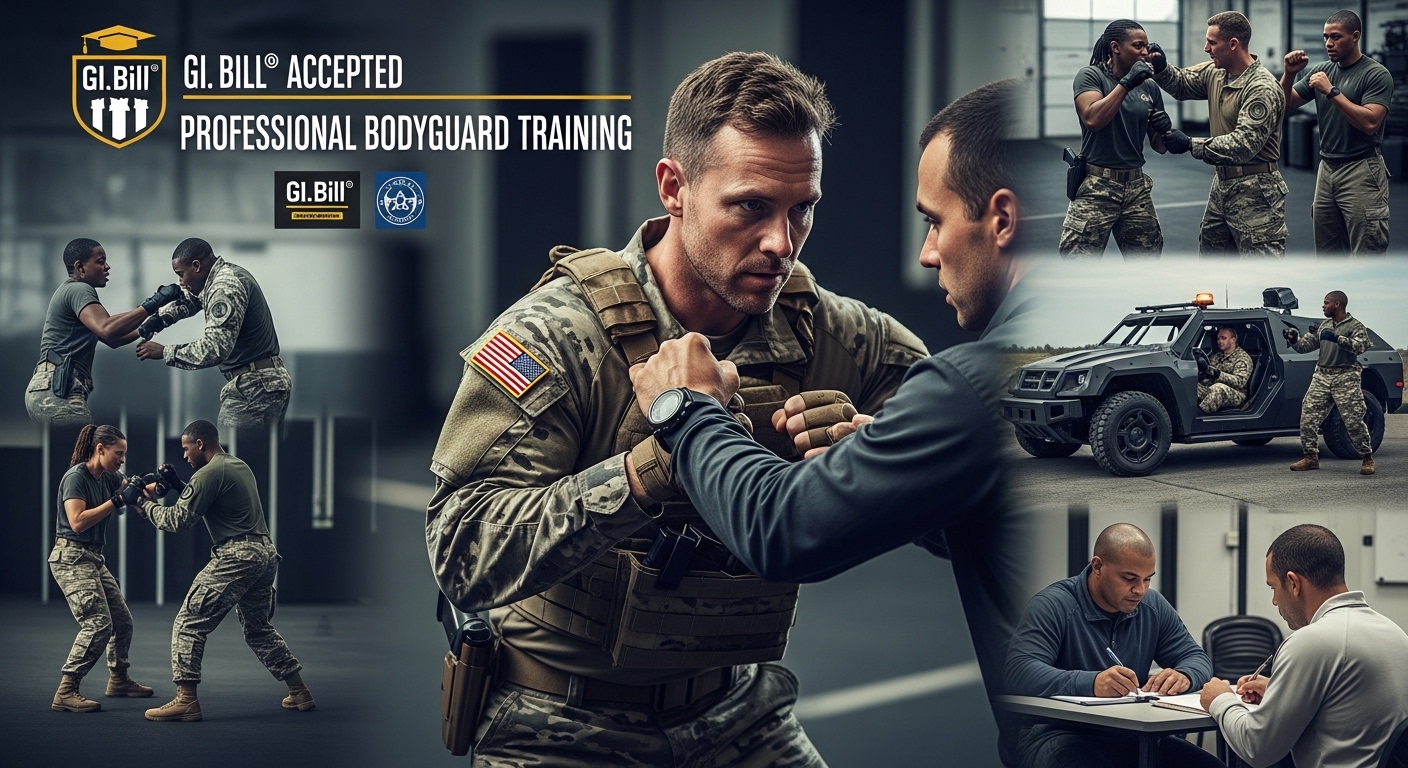
For veterans and former law enforcement officers (LEOs), the shift from public service to the private sector represents a high-ceiling career opportunity. However, the operational realities of corporate and high-net-worth (HNW) security are fundamentally different from traditional patrol or military deployment. Success in this field requires more than just foundational discipline; it requires specialized professional bodyguard training that recalibrates tactical knowledge for the nuances of private-sector liability, client etiquette, and high-stakes risk management.
Bridging the Gap: The LEO-to-EP Transition
The International Association of Chiefs of Police (IACP) frequently discusses the “second career” of officers in the private security space. The primary challenge identified is the transition from a “command and control” environment to a “service and protection” environment. In public policing, the officer represents the authority of the state. In executive protection (EP), the specialist is an employee of the principal. This necessitates a mastery of “soft skills”—etiquette, corporate protocol, and high-level communication—that are often secondary in traditional law enforcement.
Elite educational programs act as the “finishing school” for these professionals. It takes the “hard skills” of the military and police and adds the “polish” required for working with HNW families and corporate executives. This involves mastering “The Quiet Professional” philosophy—the ability to identify and mitigate threats without drawing attention to the principal or escalating a situation unnecessarily.
Regulatory Foundations: Guard Card and Security Training
In California, every specialist must hold the legal credentials to operate before they can pursue elite contracts. This starts with foundational security guard training and guard card training mandated by the Bureau of Security and Investigative Services (BSIS). These courses establish the legal baseline for the “Power to Arrest” and “Appropriate Use of Force” (AOF).
While the basic guard card provides the “license to work,” the transition from a standard guard to a certified specialist involves advanced firearms training. Obtaining a BSIS Exposed Firearms Permit involves rigorous range work, tactical reloads, and a 16pf psychological assessment. This ensures that the specialist is not only proficient with their weapon but also mentally stable and prepared for the moral weight of armed protection work. The training specifically focuses on the use of firearms in a protective bubble, where the priority is the evacuation of the principal, not the neutralization of a combatant.
The Veteran Advantage: Maximizing the GI Bill
One of the most powerful tools for a transitioning veteran is their veterans education benefits. Because top-tier academies are GI Bill® Accepted , former service members can apply their earned benefits to a 10-week intensive academy. This is a highly efficient use of entitlements; a 10-week CESS (Certified Executive Security Specialist) program typically deducts only three months of eligibility while providing a full Monthly Housing Allowance (MHA).
Furthermore, veterans assistance through Chapter 31 (VR&E) is available for those with service-connected disabilities. This program treats executive protection as a vocational rehabilitation pathway, providing the training, equipment, and coaching necessary for a career that AI cannot automate. For those traveling from across the country, Lodging Assistance Available ensures that the logistical burden of the 10-week immersion is minimized. With a 70%+ job placement success rate, the transition into the private sector is a secure and strategic move for any veteran.
Tactical Mastery: EVOC and Medical Response
A cornerstone of the 10-week intensive program is the Emergency Vehicle Operations Course (EVOC). Precision driving in an EP context is not about speed; it is about weight transfer, braking, and offensive/defensive maneuvers designed to extract a principal from a hostile environment. This is paired with Tactical Emergency Casualty Care (TECC), which focuses on managing the “Golden Hour” of a trauma incident. A protector must be able to apply tourniquets, manage airways, and coordinate with Level 1 trauma centers—all while maintaining the security of the detail. This holistic approach ensures that the veteran is not just a protector, but a life-saving asset for the principal.