






Video is the undisputed heavyweight champion of modern digital content. Whether you are a marketer pushing a new product campaign, an educator building tutorials, or a digital creator growing a YouTube channel, video drives engagement in ways static text and images simply cannot match. However, the traditional video production pipeline has always had a glaring bottleneck: post-production.
Historically, video editing required a high degree of technical expertise and hours of meticulous labor. Editors had to sift through gigabytes of raw footage, cut out dead air, sync audio tracks, and add transitions manually. For independent creators and busy teams, this steep learning curve and massive time commitment often prevented them from scaling their content output to meet audience demands.
Today, the integration of Artificial Intelligence (AI) and Large Language Models (LLMs) is fundamentally shifting the landscape. By replacing complex timelines with conversational prompts, creators can now assemble, refine, and polish their visual stories in record time.
The Shift from Manual Timelines to Prompt-Based Assembly
The most daunting phase of video editing is the initial assembly—staring at a folder full of unorganized clips and trying to stitch together a coherent narrative. This “rough cut” phase is traditionally a tedious, drag-and-drop process that drains a creator’s energy before the real creative work even begins.
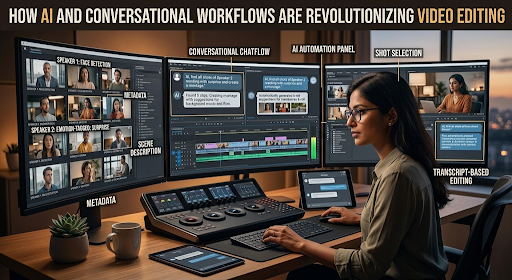
Conversational AI editing removes this friction entirely. Instead of interacting solely with multi-track timelines and razor tools, modern creators can communicate with editing software just as they would with a human assistant. By utilizing natural language processing, you can upload your raw media and simply type out instructions.
You can tell the AI what mood you are aiming for, which specific moments to prioritize, and the overall pacing required for your project. The AI analyzes the uploaded media, interprets your text, and automatically structures a baseline narrative. This rapid translation from a written concept into a visual sequence saves hours of manual labor and completely eliminates the intimidation of a blank canvas.
Bridging the Gap: Integrating ChatGPT with Video Production
The real breakthrough in this space is the seamless integration between powerful AI chatbots and professional video editing engines. We are now seeing specialized plugins that bridge the gap between text-based brainstorming and actual timeline generation.
For instance, leveraging a ChatGPT video editor free workflow allows creators to combine conversational instructions with their own raw footage. By using specialized plugins directly inside the chat interface, the workflow is incredibly straightforward. You upload your video clips and provide a clear prompt such as, “Create a fast-paced 60-second social media promo from these clips, prioritize the action shots, and cut out any silences.”
The AI processes the request, reviews your footage, identifies the most useful moments, and automatically trims away unnecessary sections. It then arranges the selected clips into an editable rough-cut timeline. You aren’t just getting a generic AI-generated video; you are getting a highly structured edit using your own authentic footage, directed entirely by your own natural language instructions.
Context-Aware Templates and Automated Polishing
Even with a solid rough cut, a video needs a cohesive aesthetic to truly capture an audience’s attention. Finding the right transitions, color grades, and text overlays manually can disrupt your creative flow and add hours to your production time.
Advanced AI editing workflows actively analyze the visual content of your uploaded footage alongside the context of your written prompt. Based on this dual analysis, modern tools feature intelligent capabilities that streamline the entire polishing process:
- Smart Template Matching: The AI can automatically match your clips with highly suitable design templates from extensive asset libraries based on your specified format and visual style. If you are producing an energetic travel vlog, it will apply fast-paced cuts; for a corporate explainer, it will suggest clean, professional transitions.
- Automated Dead-Air Removal: AI processing can instantly detect and remove awkward pauses or filler words, tightening the pacing without making the dialogue sound choppy or robotic.
- Speech-to-Text Subtitling: Automated engines generate perfectly synchronized, stylized captions in multiple languages, making the tedious administrative tasks of video editing virtually disappear.
Maintaining Total Creative Control
A common misconception about AI-assisted video editing is that it forces the creator to accept a rigid, machine-generated final product. Critics often worry that automation will remove the human touch and emotional nuance from the artistic process.
In reality, the best AI video tools are designed to serve as collaborative creative assistants, not autonomous replacements for human ingenuity. When an AI generates a rough cut, applies a visual template, or syncs dynamic subtitles based on your conversational prompt, the resulting timeline remains fully unlocked and editable.
You are never forced to accept the AI’s initial structural decisions. Once the baseline edit is transported into the primary video editor, you have complete freedom to manually trim clips, adjust audio levels, swap out transitions, change font styles, and apply custom color grading before exporting the final file. The AI handles the heavy lifting of the initial assembly, giving you more time and mental energy to focus on refining the narrative, tone, and final creative polish.
Frequently Asked Questions (FAQs)
What exactly is a ChatGPT-integrated video editor?
It is a software workflow that utilizes a Large Language Model to assist in video creation. By using a specialized plugin, you can type conversational instructions to direct the editing process. The AI analyzes your text and your uploaded raw footage, automatically selecting, trimming, and arranging the clips into an editable rough cut on a timeline.
Do I need advanced technical skills to use these AI video tools?
Not at all. The primary advantage of prompt-based video editors is their overall accessibility. Because the initial editing process is driven by natural language prompts, you do not need to understand complex multi-track timelines, keyframe animations, or color grading interfaces to generate a high-quality video draft. If you can type a descriptive sentence, you can build a video.
Can I use my own raw footage, or does the AI only generate synthetic video?
While some AI generators create synthetic video from scratch, professional AI editing workflows allow you to upload your own raw video and audio files. The AI acts as an assistant to organize, cut, and structure the authentic media you provide, ensuring your content remains genuine and highly personalized.
Will the AI lock my final video, or can I still make manual changes?
You retain 100 percent creative control. The AI’s output is intended to be a foundational first draft. Once the initial timeline is generated, you can open it in the primary video editor to manually swap clips, adjust micro-transitions, rewrite captions, and refine the audio levels before you export the final, polished file.
How does AI help with video accessibility and audience retention?
AI drastically improves video accessibility by automatically generating highly accurate closed captions and subtitles in real-time. Since a massive majority of mobile users watch videos with the sound muted, stylized and dynamic captions keep viewers actively engaged. Additionally, many AI tools offer multi-language translation, allowing you to reach a global audience effortlessly.
Conclusion
The technical barriers to high-quality video production are dissolving faster than ever before. By embracing conversational AI and intelligent timeline automation, anyone from a solo digital creator to a corporate marketing team can bypass the most frustrating, time-intensive aspects of post-production.
Whether it is translating a text prompt into an instant rough cut, automatically matching authentic footage to dynamic templates, or generating globally accessible subtitles, AI acts as a tireless digital assistant. It dramatically scales your creative output while ensuring you retain ultimate control over your story. The future of digital content creation belongs to those who learn to collaborate effectively with these emerging technologies, merging human creativity with incredible machine efficiency.